

Dermaplaning vs Microdermabrasion: Which Is Right for You?
How dermaplaning and microdermabrasion differ, what each one feels like, who each suits, and how to choose between them, from a licensed esthetician's spa.
Reviewed by Demi Broughton, Licensed Esthetician
Dull, rough skin that drinks up moisturizer and still looks flat is one of the most common reasons people book a facial. Dermaplaning and microdermabrasion both go after that dull top layer, and they get mentioned together so often that it’s easy to assume they’re the same thing; they aren’t, and the difference matters when you’re choosing one.
The short answer
Both are forms of physical exfoliation. Both work on the outermost layer of skin, the layer of dead cells that makes a complexion look dull and keeps products from reaching fresher skin underneath. Neither one needs downtime in the usual sense.
The difference is in the tool and what it removes:
- Dermaplaning uses a sterile blade to sweep away dead surface cells and the fine, soft hair (vellus hair, or “peach fuzz”) that sits on top of them.
- Microdermabrasion uses a machine with either fine crystals or a diamond-tipped wand, plus gentle suction, to buff away dead cells and lift away the debris.
So if fine facial hair is part of what’s bothering you, dermaplaning is the one that addresses it. If your main concern is clogged-looking pores and rough texture, a machine-based treatment with suction may suit you better.
What dermaplaning is
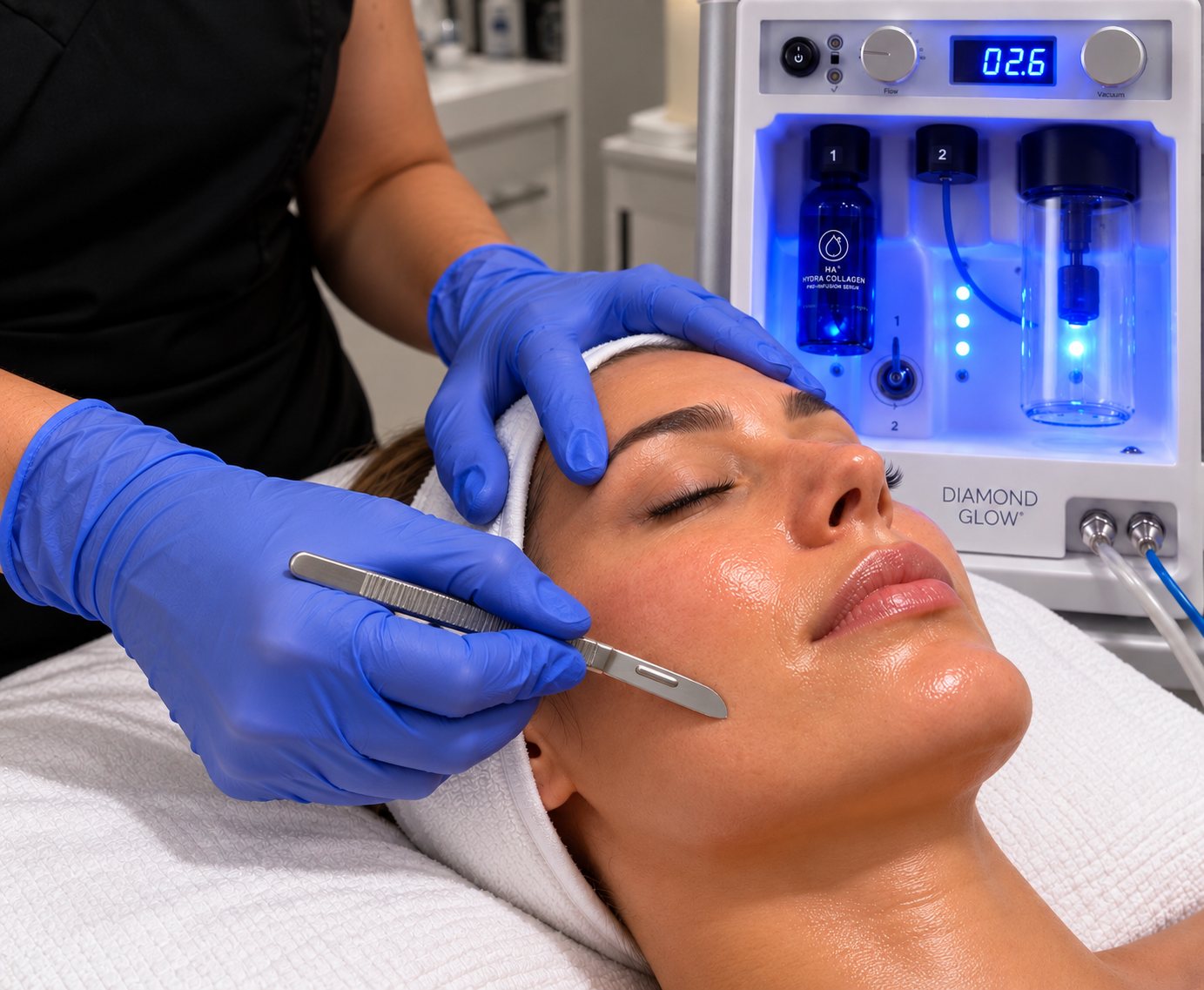
During dermaplaning, the esthetician holds a sterile blade at roughly a 45-degree angle and works across the face in small sections with short, light strokes. It feels like a very soft scraping, closer to a light shave than anything sharp.
What it does well:
- Smoothness. Removing dead cells and peach fuzz together leaves skin feeling noticeably soft.
- Makeup that sits better. Foundation glides on instead of catching on fine hair. This is a big part of why people book it before events.
- Brightness. Vellus hair and dead cells both scatter light. Without them, skin tends to look clearer and more even.
- Better use of your skincare. With the dead-cell layer cleared, serums and moisturizers reach skin more easily.
A common worry is that the hair will grow back thicker or darker. It won’t. Vellus hair is set to a certain thickness and color, and cutting it doesn’t change the follicle. The regrowth can feel a little different for a few days because the cut end is blunt, but it’s the same hair.
What microdermabrasion is
Microdermabrasion is a machine-based treatment. There are two main styles. Crystal microdermabrasion sprays fine crystals across the skin and vacuums them back up along with dead cells. Diamond-tip microdermabrasion uses a wand with a textured diamond tip to buff the surface while suction lifts away what’s loosened.
The suction is the part people often like most: it helps pull out surface debris from pores while the skin is being exfoliated. Skin may look a little pink for a short while afterward, and many people book these treatments as a regular routine rather than a one-off, since the effect on dullness and texture builds with consistency.
What microdermabrasion doesn’t do is remove facial hair. If peach fuzz is part of what you want gone, it won’t change that.
Dermaplaning vs microdermabrasion, side by side
| Dermaplaning | Microdermabrasion | |
|---|---|---|
| Tool | Sterile blade, by hand | Machine with crystals or a diamond tip, plus suction |
| Removes peach fuzz | Yes | No |
| Pore debris | No suction | Suction helps lift surface debris |
| Feel | Light scraping, like a soft shave | Light buffing with a gentle pulling sensation |
| Afterward | Slight pinkness for a few minutes | Often a little pink for a short while |
| Typical spacing | Every four to six weeks | Often monthly or as a series |
How to choose
A few questions usually settle it:
- Is fine facial hair part of the problem? Choose dermaplaning, or a visit that includes it.
- Do your pores look congested, or does your skin feel bumpy rather than just dull? A machine-based treatment with suction is often the better fit.
- Do you have an event coming up? Either can work, but timing matters. Dermaplaning is commonly booked two to three days before, and a DiamondGlow one to three days before, so any pinkness has settled. If you’re planning a series, our guide on how often to get a facial walks through spacing.
- Is your skin sensitive? Both can be adjusted. Mention it at your consultation so the plan starts gently.
Many people end up not choosing at all. Dermaplaning first, followed by a machine-based treatment, is a common pairing because the second step reaches skin that’s already been cleared.
Who should skip both, for now
Physical exfoliation isn’t the right step for every face at every moment. Hold off and talk to your esthetician first if you have:
- Active, inflamed breakouts. A blade or wand passing over them can spread bacteria and irritate the area further.
- Cold sores, open areas or broken skin.
- Redness-prone skin that’s in a flare-up.
- Recent or current isotretinoin (Accutane) use, prescription retinoids, or a recent cosmetic procedure. Check with your doctor first and mention it at your consultation. Skin Restore does not perform dermaplaning on anyone who has taken isotretinoin within the last six months.
- Pregnancy or nursing, or any medical skin condition you’re being treated for. Ask your doctor, and let your esthetician know.
If breakouts are the main concern, a different plan, such as a series of professional peels, is often the better conversation to have.
What to expect at Skin Restore
At Skin Restore in San Clemente, dermaplaning is offered two ways. As a standalone treatment it takes about 30 minutes: cleansing and prep, dermaplaning the whole face in careful sections, then a treatment mask and serums chosen for your skin. As an add-on it takes about 15 minutes at the start of another treatment, and it pairs particularly well with BREEZE or DiamondGlow.
The spa doesn’t offer classic crystal microdermabrasion. Its closest equivalent is the DiamondGlow facial, which uses a diamond-tipped wand with suction to exfoliate and extract, while delivering a serum into the freshly exfoliated skin in the same pass. That last step is what sets it apart from standard microdermabrasion. You choose from five serum types (hydration, brightening, clarifying, skin-firming and pore clarifying) based on what your skin is doing that day. The appointment runs about 30 to 45 minutes, and skin may look a little pink for 15 to 30 minutes afterward.
DiamondGlow and dermaplaning are often booked together in one visit. A peel isn’t combined with DiamondGlow on the same day.
Every appointment is with Demi Broughton, a licensed esthetician with 17 years of experience, who will look at your skin before recommending either one. Results vary from person to person, and pricing is confirmed at your consultation. You can see the full menu on the treatments page. The spa serves clients from across South Orange County, including Dana Point, San Juan Capistrano and Laguna Niguel.
Common questions
Is dermaplaning or microdermabrasion better for peach fuzz?
Dermaplaning. The blade removes the fine vellus hair along with dead surface cells. Microdermabrasion exfoliates the surface but isn't designed to remove facial hair.
Can you do dermaplaning and microdermabrasion together?
They can be paired in the same visit when your skin tolerates it, usually with dermaplaning first so the second step reaches clear skin. At Skin Restore, dermaplaning is often added to the start of a DiamondGlow. Your esthetician will decide based on how your skin looks that day.
Which one is gentler?
It depends on the skin and the settings. Dermaplaning is a single, light pass with no suction. Machine exfoliation can be dialed up or down. If your skin is sensitive, say so at your consultation so your esthetician can start conservatively with either one.
How long does redness last after each?
Dermaplaning usually leaves slight pinkness for a few minutes. A diamond-tip treatment such as DiamondGlow may leave skin a little pink for about 15 to 30 minutes. Most people go straight back to their day.
Does dermaplaning make hair grow back thicker?
No. Vellus hair grows back at the same thickness and color. The regrowth can feel slightly different for a few days because the cut end is blunt rather than tapered, but the hair itself hasn't changed.
This article is general education, not medical advice. Which treatment suits your skin is decided at your consultation.